- Reflection
- India
- Systems thinking
Jagriti Yatra began for me on December 25, 2016 and carried into January 2017, but what stayed with me was not a date range. It was a before and after.
Before Jagriti, I thought in stories about ambition, growth, and opportunity. After Jagriti, I started thinking more seriously about systems, institutions, logistics, and the hidden machinery that makes progress real.
I boarded the Jagriti Yatra train in December 2016 with a tidy, overly optimistic belief: that I understood India because I had grown up around it.
Fifteen days later, I realized I had mostly understood a narrow slice of India, the slice that speaks English fluently, moves fast, and mistakes momentum for progress.
Jagriti didn’t “teach” me India. It made me bump into it, repeatedly, at speed, with no time to sanitize the experience into a neat takeaway.
That train became a strange kind of operating system. Everything ran in cycles: wake up, move, absorb a role model visit, come back, debrief, argue, build, sleep, repeat. You’re tired in a way that makes your filters weak, so the reality gets through.
And once it gets through, you can’t unsee it.
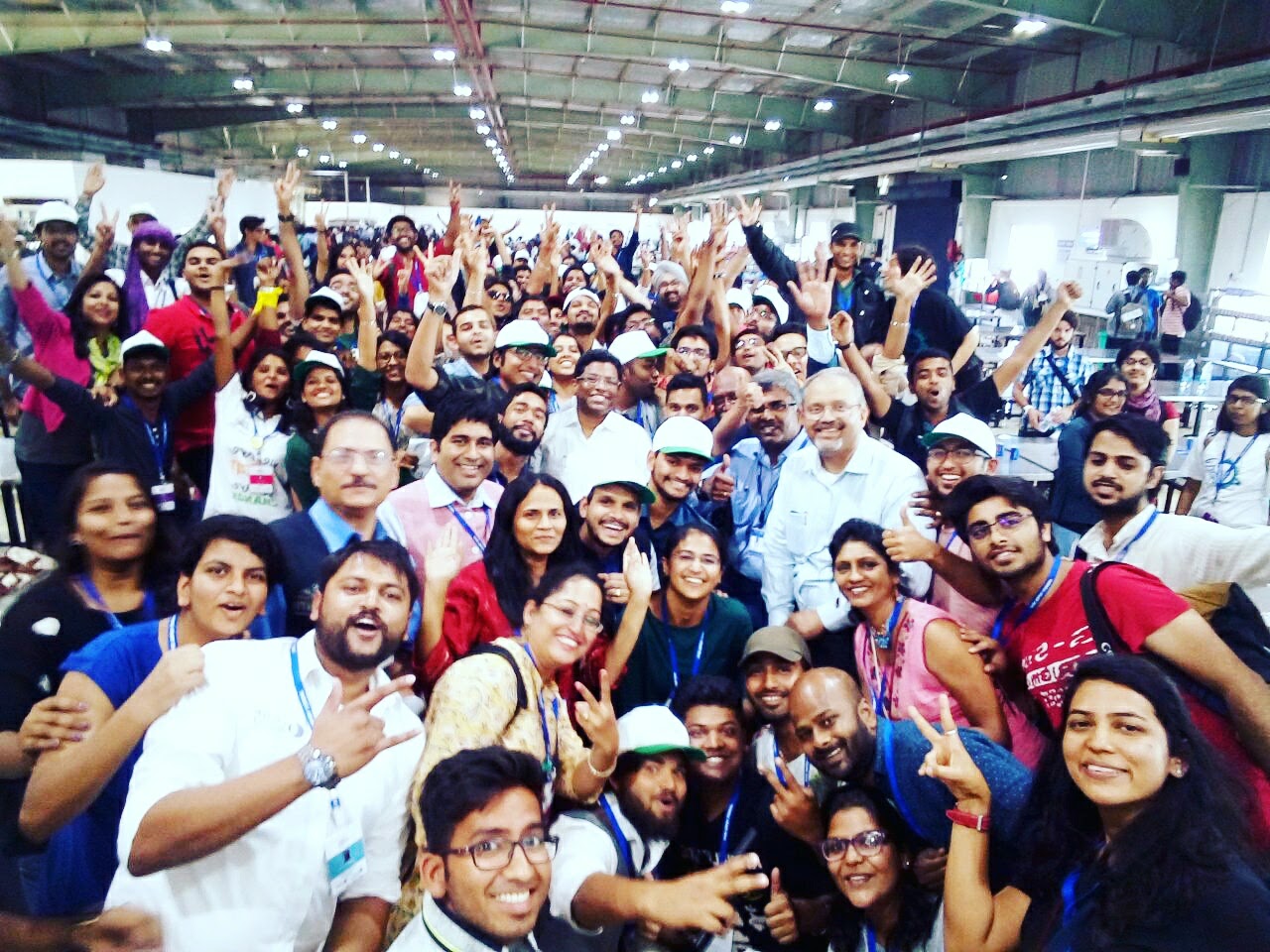
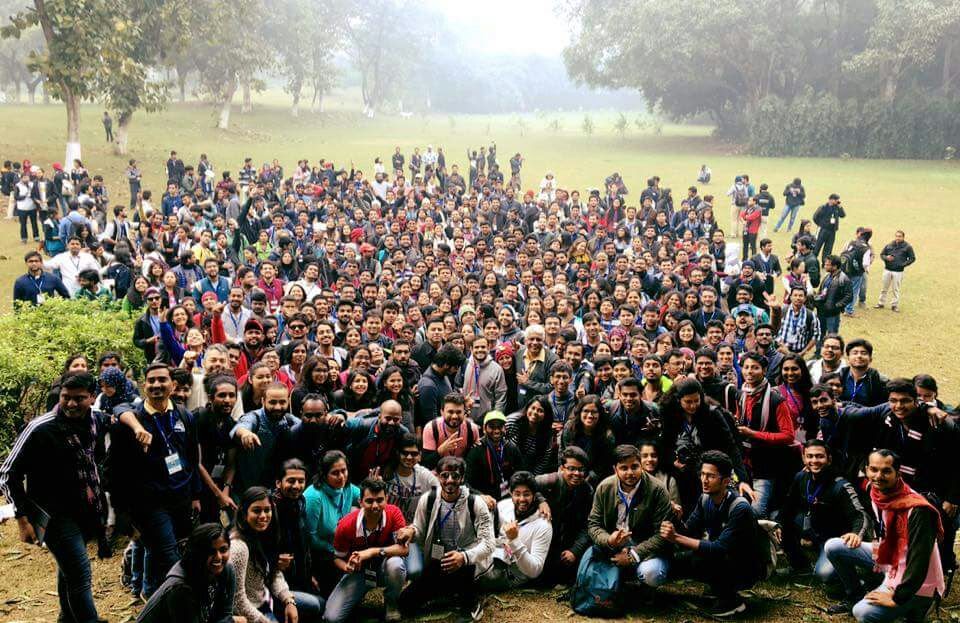
I still remember the earliest moments at the start in Mumbai: the crowd, the logistics, the feeling of being one person in a moving population of wildly different lives. There’s something humbling about watching a large system work quietly so that you can do something as simple as show up and learn. Your brain starts noticing the invisible labor: staff, scheduling, food, headcounts, the choreography of moving hundreds of people without losing anyone.
Somewhere early on, I was voted facilitator for my group.
It wasn’t ceremonial. It was practical. When you put a team of strangers together, different ages, different languages, different skill sets, you don’t need a leader who talks the most. You need someone who can hold the group steady when the environment is noisy. You need someone who can notice when the loud are dominating and the quiet are disappearing. Someone who can turn chaotic conversation into something usable.
Facilitation on Jagriti is not about being the smartest person in the room. It’s about being the person most responsible for the room.
That became my first real lesson: leadership isn’t authority. It’s attention.
Phase 1, Explore
The first phase of the journey felt like learning to see India with less certainty and more honesty.
The first stop that rearranged me was Dharwad, Kalkeri Sangeet Vidyalaya, what everyone casually calls the musical village. It didn’t look like my mental model of a high impact institution. It was not built to impress. It was built to function.
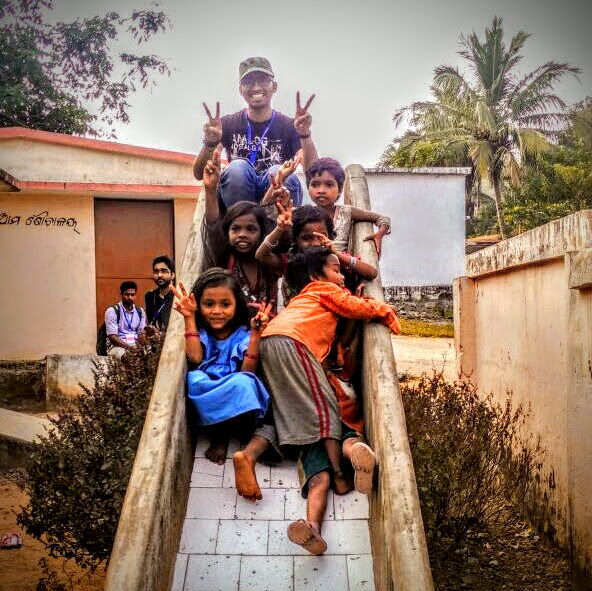
And then the kids, focused, loud, laughing, alive.
Here was a school where classical music wasn’t treated as a luxury. It was treated as a core skill, a discipline, a future. The place carried this quiet conviction that dignity can be taught, not by speeches, but by daily practice.
One moment from Kalkeri is burned into my head: a panchayat style gathering. The scene felt almost unreal in its contrast, small, fair skinned children wearing traditional Indian outfits, sitting in a setting that made you feel like culture wasn’t being performed, it was being lived. That image bothered me in a good way. It poked at my assumptions about who belongs where, what is modern, and what we unconsciously label as backward.
It was the first time on the journey I caught myself thinking: maybe we’ve been measuring progress with the wrong instruments.
From there, Bengaluru hit like a hard gear shift.
You move from a rural campus that feels like a pocket of intentional calm into a city that runs on ambition and friction. Bengaluru is familiar to a lot of us: startups, speed, the belief that anything can be built if you can hire well and raise money.
But Jagriti’s version of Bengaluru wasn’t about the city’s mythology. It was about role models, people who built businesses for India, not businesses that pretend India is the West with cheaper labor.
At the Jagriti Enterprise Mela, the message wasn’t abstract: entrepreneurship isn’t a motivational poster, it’s a distribution problem. It’s a pricing problem. It’s a trust problem. It’s a question of who will actually use this and why.
I remember listening to leaders speak and noticing something subtle: the best of them didn’t glamorize the struggle. They just made it legible. They spoke in constraints. They spoke in tradeoffs. They spoke like builders.
Phase 2, Connect
The second phase was when the visits stopped feeling separate and started forming one connected picture.
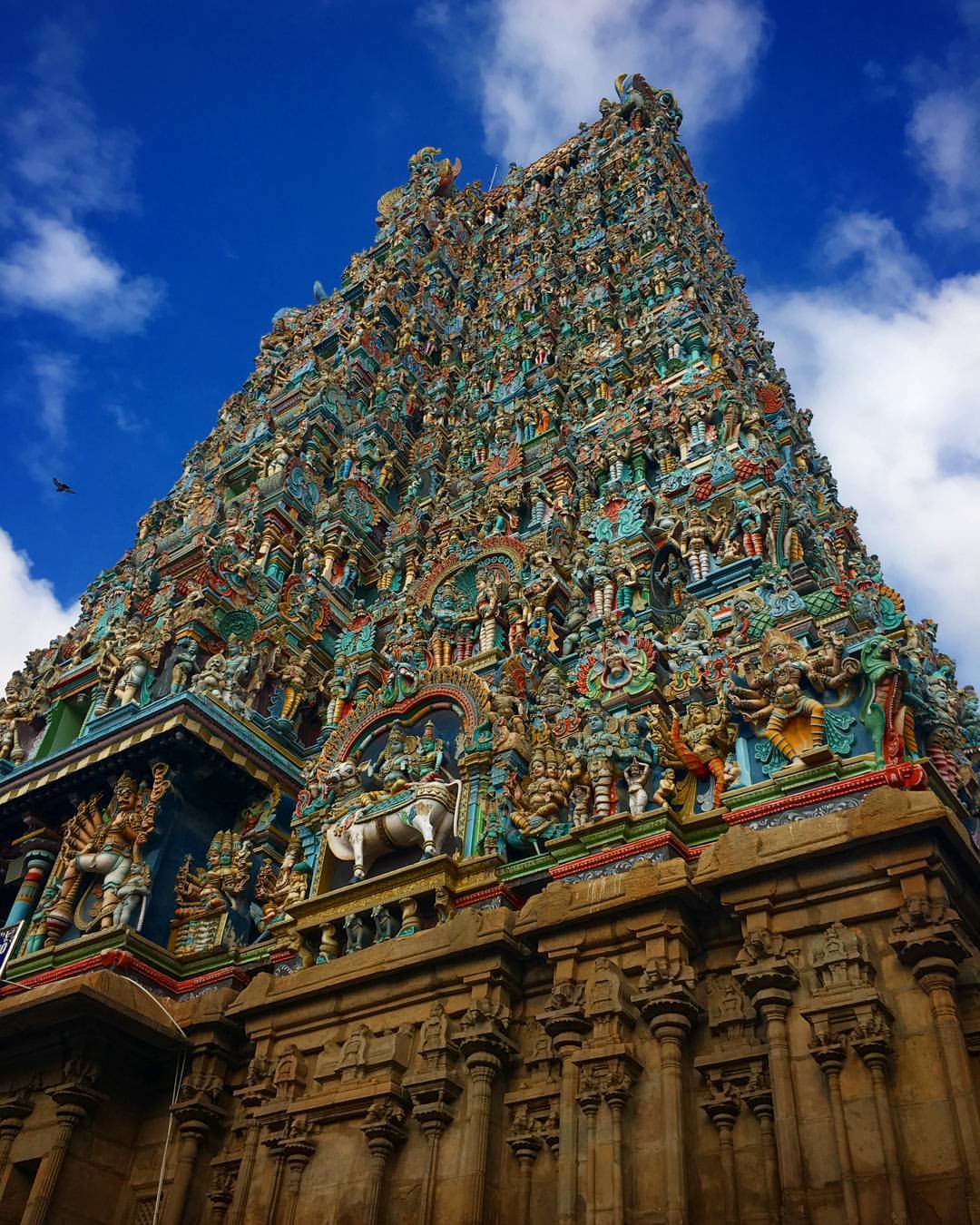
Then came Madurai and Aravind Eye Care.
If Kalkeri challenged my view of education, Aravind challenged my view of scale.
I had heard people talk about social entrepreneurship like it was a softer cousin of business, noble, but operationally fragile. Aravind is the opposite. It’s social impact executed with industrial discipline.
What you witness there is not just compassion. It’s process design. It’s throughput. It’s the kind of system thinking where outcomes are engineered, not wished for.
The profound part isn’t that they do eye surgeries. The profound part is that they prove a model: you can deliver high quality care at volume, and still protect dignity.
Standing inside that ecosystem, you stop asking whether impact can scale. You start asking why more systems don’t.
And then Sri City.
This was the stop that made the contrasts unavoidable.
Sri City felt like someone had drawn a straight line through chaos. A planned industrial ecosystem. Global manufacturing logic. Infrastructure designed so that businesses can plug in and run. It had that atmosphere of long horizon thinking, where the work is not exciting day to day, but the compounding is massive.
It made me uncomfortable because it exposed another blind spot: I used to talk about jobs like they were a macro economic concept. Sri City makes jobs feel like something physical, roads, power, water, logistics, predictable governance. It’s not romantic, but it is foundational.
In my head, I started connecting dots I hadn’t connected before: what does it take to uplift a region? Not inspiration. Not slogans. A repeatable economic engine.
Later, when we had to build our business plan, my group leaned toward a bold idea: what if you could propose a Sri City style zone, adapted to local constraints, to uplift a region? Not because SEZ is a magic word, but because ecosystems matter. You don’t just need entrepreneurs. You need supply chains. You need skills. You need market access. You need institutions that don’t collapse when the founding team gets tired.
That’s one thing Jagriti does exceptionally well: it forces you to see entrepreneurship as the intersection of individual agency and institutional design.
Visakhapatnam came next, Akshaya Patra and the Naval Dockyards.
On the surface, those two visits feel unrelated. But the underlying lesson is the same: serious outcomes require serious operations.
Feeding millions of children isn’t a feel good story. It’s an operations story. It’s procurement, kitchen design, safety standards, staff training, routing, reliability. It’s what happens when compassion grows up and becomes competent.
The Naval Dockyards, in a different way, show you the same thing: scale, security, maintenance, precision, systems that don’t get to fail casually.
By the time New Year’s arrived, something had changed.
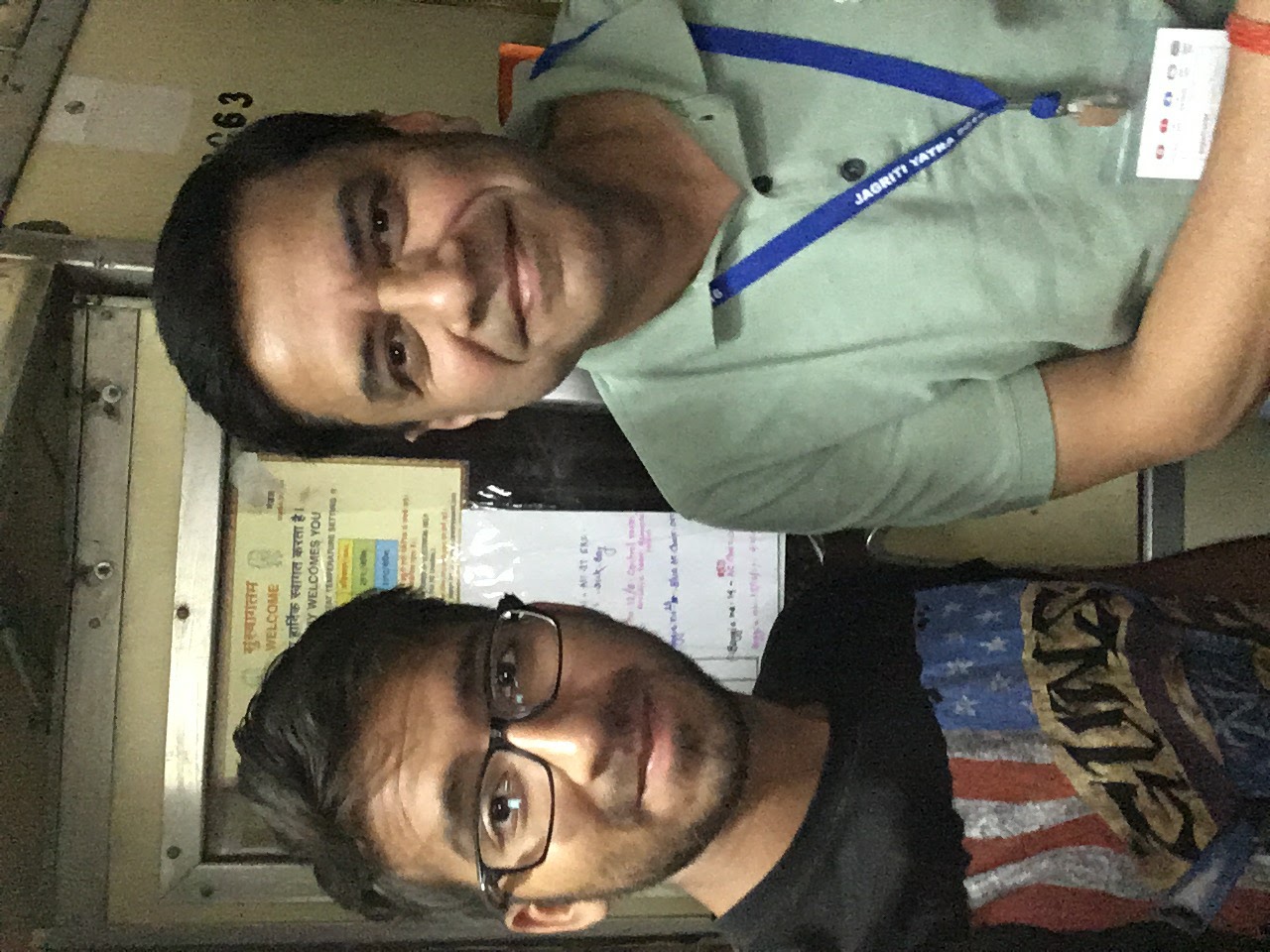
We didn’t do New Year’s the way people usually do it. We did it on a train that had become a moving home. There’s a specific intimacy to celebrating time on a train: you’re not going out, you’re already inside the thing that’s carrying you.
And the mood was not just party energy. It was reflection energy, disguised as celebration.
New Year’s on the train felt symbolic: you’re literally crossing into a new year while moving through the country, surrounded by people who are attempting, in their own ways, to move India forward.
Then Berhampur and Gram Vikas, water and sanitation, the kind of work that rarely gets glamour but changes everything.
If you want humility, go look at infrastructure you take for granted. Gram Vikas makes you sit with how basic needs are not basic when systems are broken. It’s not enough to build a toilet. You need social infrastructure: participation, ownership, upkeep, inclusion. The engineering is hard, but the human systems are harder.
Around this time, the Jagriti rhythm starts to reshape you: you stop looking for inspiration. You start looking for mechanisms.
Phase 3, Rebuild
The third phase was where the journey started rebuilding how I thought, not just what I thought.
And then Uttar Pradesh.
Barpar near Deoria was the first real pause: the first night off the train. The cold was sharp. The fog made everything feel quieter and more honest. You didn’t need a lecture to understand the gap between urban convenience and rural reality. You could feel it in the air.
This is also where the business plan became real.
On the train, a plan can stay theoretical. In a village, you can’t hide behind frameworks. People’s questions are not about what looks good on a slide. They’re about whether this survives.
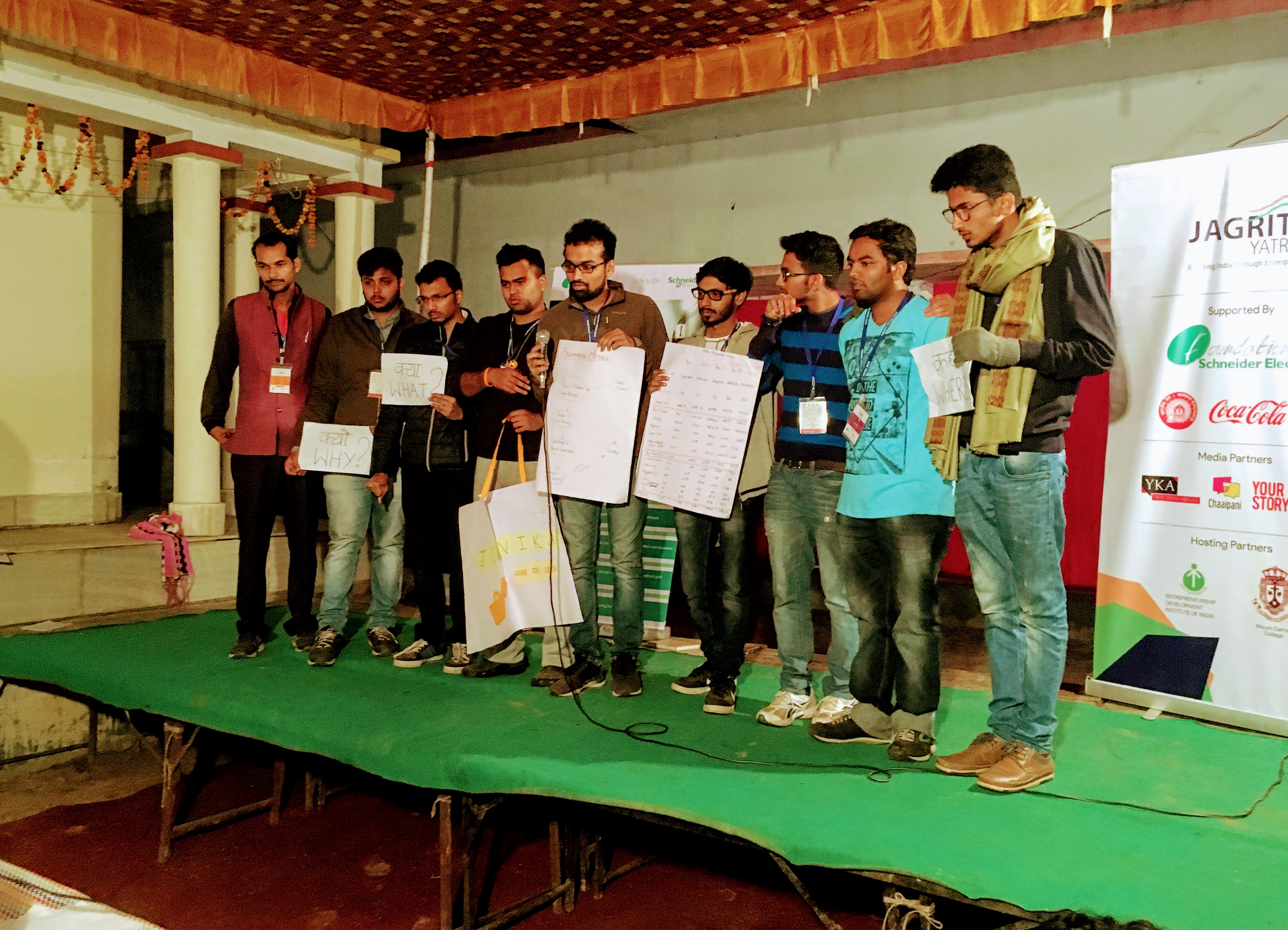
In our case, we had a compressed sprint, two to three days of intense building, trying to propose something that wasn’t just a startup idea, but a regional uplift mechanism. There’s a difference. A startup solves a problem. A regional uplift mechanism changes the local game board.
That night, I remember thinking: if I ever build something serious in India, I cannot build from assumptions. I have to build from observation.
Eventually, the journey looped north: Delhi, Goonj, Barefoot College, Ahmedabad.
Goonj was one of those experiences that permanently distorts your definition of waste. It’s not just recycling. It’s reassigning value. It’s the type of system design where dignity is not a slogan, it’s a constraint the system must satisfy.
Barefoot College made a different point: capability doesn’t need to be imported. It can be trained locally. And when you train it locally, it sticks.
By the time we reached Sabarmati Ashram, I didn’t feel hyped. I felt recalibrated.
That’s the honest outcome of Jagriti Yatra: it doesn’t give you a single life changing quote. It gives you a new lens.
A lens that makes you notice how India actually works, how it fails, how it adapts, how it builds, how it survives. A lens that makes you respect quiet competence more than loud ambition.
And when the train finally moved back toward Mumbai, I realized something about that New Year’s moment.
New Year’s on the train wasn’t just a fun story. It was a metaphor for what the journey does to you: it marks a boundary.
You enter Jagriti with a version of yourself that thinks in narratives.
You leave with a version of yourself that thinks in systems.
That is probably the cleanest conclusion I can draw from the whole experience. Jagriti Yatra did not just widen my perspective on India. It changed the questions I ask when I look at any ambitious system. I look for the hidden labor. I look for the operating model. I look for the institution behind the idea. And I look for whether the thing can last after the first burst of energy is gone.
Route table
The distances below are approximate leg distances from the previous major stop on the 2016 to 2017 route, not exact rail-tracking totals.
| Day | Date | Destination / place | Approx km from previous stop | Main visit or anchor | Why it mattered |
|---|---|---|---|---|---|
| Day 1 | Dec 25, 2016 | Mumbai, Maharashtra | Start | Jagriti kickoff and opening context | The journey begins with the framing for enterprise led development and the scale of the Yatra itself. |
| Day 2 | Dec 26, 2016 | Kalkeri, Dharwad, Karnataka | ~620 km | Kalkeri Sangeet Vidyalaya | Education, arts, dignity, and discipline built through lived practice. |
| Day 3 | Dec 27, 2016 | Bengaluru, Karnataka | ~430 km | Jagriti Enterprise Mela, Mount Carmel College | Entrepreneurship becomes legible through real builders, not startup mythology. |
| Day 4 | Dec 28, 2016 | Madurai, Tamil Nadu | ~435 km | Aravind Eye Care System | Scale, throughput, and compassion can coexist inside one disciplined system. |
| Day 5 | Dec 29, 2016 | Sri City, Andhra Pradesh | ~540 km | Sri City industrial ecosystem | Jobs, infrastructure, and regional development start to feel physical and systemic. |
| Day 6 | Dec 30, 2016 | Visakhapatnam, Andhra Pradesh | ~780 km | Akshaya Patra and Naval Dockyards | Large outcomes come from serious operations, reliability, and process design. |
| Day 7 | Dec 31, 2016 | Berhampur, Odisha | ~280 km | Gram Vikas | Water, sanitation, and inclusion depend on social systems as much as engineering. |
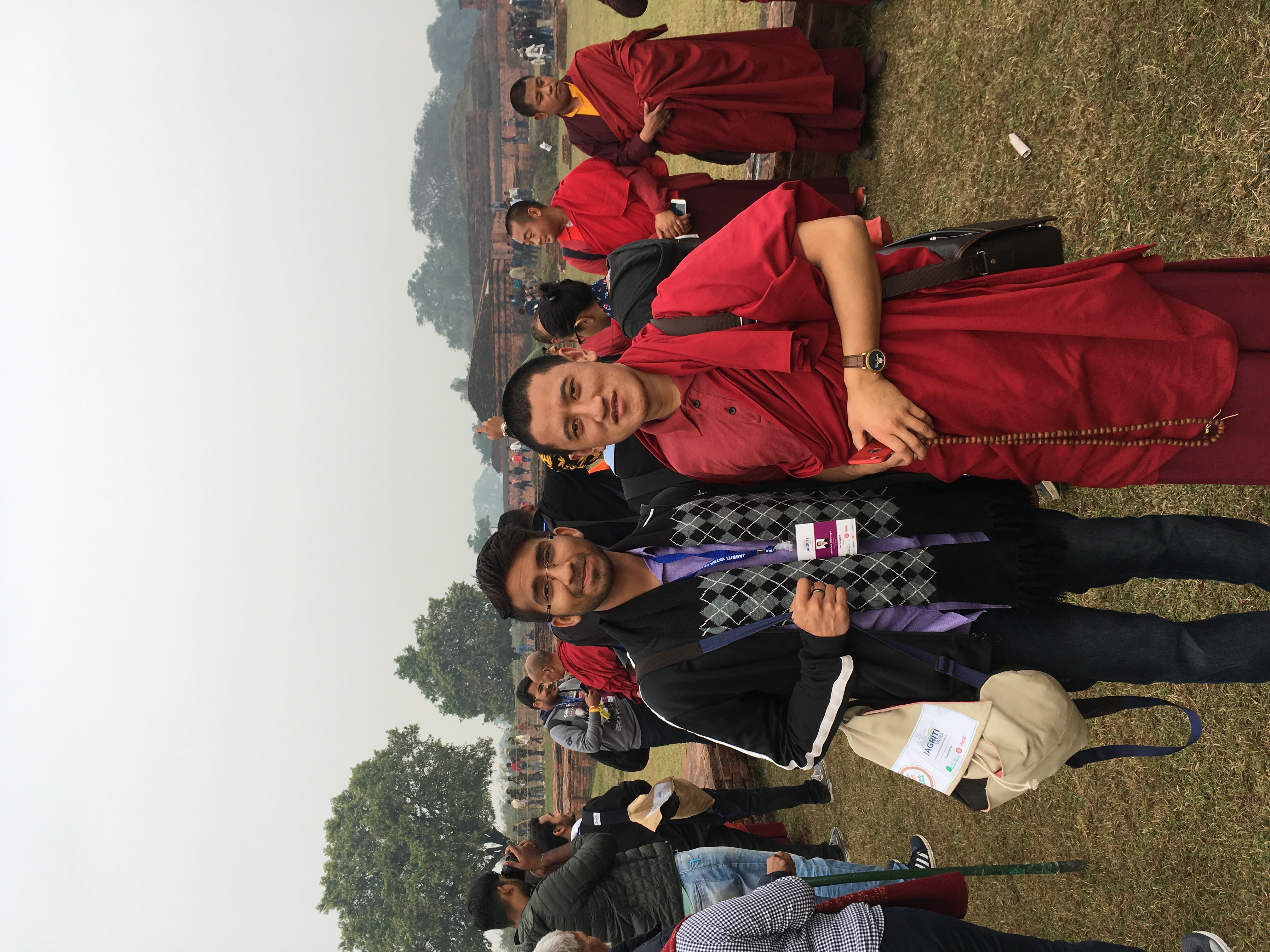
| Day 8 | Jan 1, 2017 | Nalanda, Bihar | ~690 km | Nalanda ruins and new university campus | The New Year stop reinforces learning, continuity, and the scale of civilizational institutions. |
| Day 10 | Jan 3, 2017 | Barpar, Deoria, Uttar Pradesh | ~360 km | Jagriti Sewa Sansthan and business plan validation | Rural context tests whether ideas survive beyond slides and ambition. |
| Day 12 | Jan 5, 2017 | Delhi | ~830 km | Goonj and Rajghat | Dignity, waste, and development get reframed through systems that redistribute value. |
| Day 13 | Jan 6, 2017 | Tilonia, Rajasthan | ~390 km | Barefoot College | Capability built locally is often stronger than capability imported from outside. |
| Day 14 | Jan 7, 2017 | Ahmedabad, Gujarat | ~560 km | Sabarmati Ashram | Reflection, recalibration, and a final lens on enterprise, service, and discipline. |
Jagriti Yatra in photos
Official site reference: https://www.jagritiyatra.com/